

Robotic welding
Robotic welding is a metal joining process where the weld is created by an industrial robot according to a pre-prepared program. This method is used worldwide in automotive and machinery manufacturing because the robot executes every weld identically. At the Halwelding workshop in Jelgava, we use robots to weld gates, railings, frames, and other steel structures for both private clients and small manufacturers.
Describe your project and send it to olegs@halwelding.lv or fill out the contact form. We provide price quotes free of charge.
Robotic welding service
-
Single part or multiple units
We accept orders starting from a single part. The robot provides the greatest benefit when multiple identical parts are required.
-
Structures up to 400 kg
The positioning table holds and rotates even heavy parts during the welding process.
-
Three metals
Steel, stainless steel, and aluminum.
-
EN 1090 EXC2 Certificate
The automatic welding certificate confirms compliance with European requirements for steel structures.
-
Pick-up in Jelgava or delivery throughout Latvia
Finished products can be collected at our workshop at Gala iela 4 or sent via courier.
Benefits of robotic welding
The greatest benefit of robotic welding is uniform seams, as the robot repeats the programmed movement identically; therefore, both the first and the hundredth part look the same and withstand the same load. For this reason, it is most commonly used by manufacturing companies, but individuals can also place orders with us without a minimum volume requirement.
Most frequent orders:
-
Private homeowners
Gates, fence frames, railings, and canopy structures.
-
Garden and yard landscapers
Bench and table frames, gazebos, and fire pit frames.
-
Garage and workshop craftsmen
Workbenches, shelves, stands, and subframes.
-
Car and moto enthusiasts
Mounts and frame elements based on a sample.
-
Artisans and small manufacturers
Multiple identical products with consistent quality.

What we manufacture
The robot creates a finished structure from prepared parts according to your drawing or sample:
-
Gates, fence sections, and stair railings.
-
Canopies, gazebos, and shed frames.
-
Garden furniture and bench frames.
-
Workshop tables, shelves, and tool stands.
-
Brackets, fasteners, and repair parts.
-
Multiple identical elements in a single batch.
If your idea is not on the list, send us a description, and we will let you know if we can manufacture it.
Order process
-
Send your idea
Sketch, drawing, photo, or an old part as a sample. A drawing on paper is sufficient if dimensions are provided.
-
Receive a quote
We calculate material costs, welding time, and the total price, and send the proposal to you.
-
We prepare and weld
Upon approval, we cut and secure the parts, program the robot, and weld the structure.
-
Receive your product
The deadline and delivery costs are known from the quote. Collection at the Halwelding workshop in Jelgava or delivery throughout Latvia.
Ready to order? Send your sketch to olegs@halwelding.lv or fill out the contact form.
Costs and pricing factors
If you order a single part, a large portion of the price is specifically for preparation. If you order several identical parts, these costs are distributed among them, making each part cheaper. We calculate a precise price for each order individually.
Approximate prices for frequently ordered services:
-
Steel structure manufacturing, starting from 1,850 EUR/t (1.85 EUR/kg)
-
Wet painting, starting from 22 EUR/m²
-
Powder coating, starting from 17 EUR/m²
-
Hot-dip galvanizing, starting from 550 EUR/t (0.55 EUR/kg)
-
Duplex (hot-dip galvanizing + painting), starting from 7 EUR/kg
-
Sandblasting/shot blasting, starting from 7 EUR/m²
The price is also influenced by the type of material, seam length, and product size. Price quotes are provided free of charge.

Welding robot and positioning table
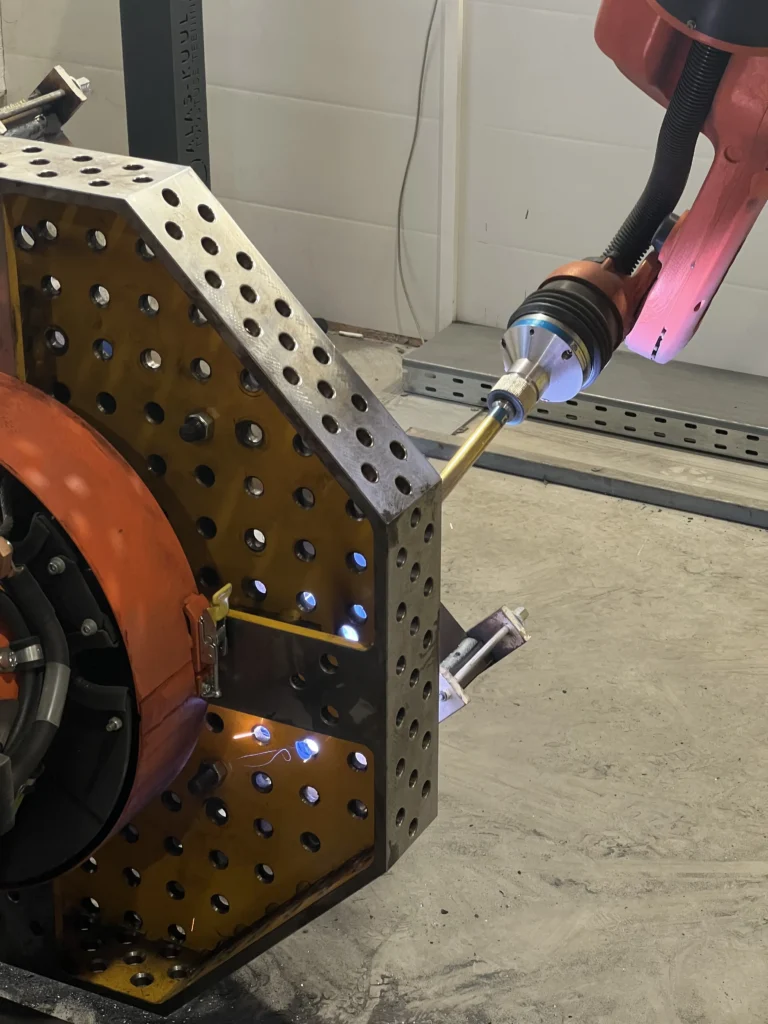
The welding process begins by securing the parts on the positioning table. The table holds structures weighing up to 400 kg and rotates them so the seam location is easily accessible to the robot. In this position, the seam is formed evenly, and the melt does not run. Therefore, the robot can also weld areas that would be difficult to reach with a manual torch.
The equipment operation is fully automated. The robot guides the torch along the programmed path, and the speed, current, and wire feed remain constant at all times. Consequently, the seam is uniform throughout its length in both appearance and durability. A human supervises the process and inspects the finished welds.
Robotic welding is performed with high precision. Robots do not experience fatigue or hand tremors, so the robot’s precision is consistent from the first to the last seam. This increases work efficiency, as the robot accomplishes more in a day than a manual welder, meaning even larger orders are completed in a shorter time.
Metal processing and materials
We work with three materials. Different metals require different current intensities and torch speeds, so we set up the robot for each job individually:
-
Steel
The most commonly used metal for gates, railings, and frames. It is easy to weld and paint. If the structure will be outdoors, it is coated with primer and paint after welding to protect it from rust.
-
Stainless steel
Does not rust and does not require painting, making it suitable for structures located outdoors or in humid environments. When welding this steel, it must not be overheated, as heat can damage the surface protective layer. This is precisely why the constant current intensity and speed of the robot are beneficial.
-
Aluminum
A lightweight material that does not rust, making it the choice for light furniture and design elements. Welding aluminum is more difficult than steel because its surface is covered with an oxide layer and heat dissipates quickly throughout the part. Therefore, we clean the surface before welding and set the robot to the current and speed intended for aluminum.

Why choose Halwelding
-
Orders without minimum volume
You can order as little as a single part from us. There are no surcharges for small orders.
-
EN 1090 EXC2 certificate
This execution class is applied in Europe to steel structures for buildings, and it confirms that the welds and their inspection meet construction requirements.
-
Metalworking in one place
We cut parts with plasma equipment and weld them in the same workshop, thereby shortening production time and eliminating the need to find multiple contractors.
-
Price known before work begins
In the price quote, we include materials, welding, and, if necessary, delivery.
-
We recommend the best solution
If another method is better suited for your idea, we will tell you openly rather than offering something that does not meet your needs.
-
Finished product, not just a part
We can also galvanize and paint the welded structure, so you receive a finished product.

Frequently Asked Questions
-
Does the robot weld even a single part?
Yes. We accept single-piece orders for welding. When ordering several identical parts, the price per unit is more favorable.
-
Is a robotic weld stronger than a manual weld?
A correctly executed manual weld is just as strong. The benefit is consistency. The current and torch speed do not change during the welding, so the quality is uniform throughout the length of the seam and between parts.
-
How heavy a structure can you weld?
The positioning table holds up to 400 kg. For larger or longer structures, please contact us, and we will evaluate the possibilities.
-
Do you weld aluminum?
Yes. For aluminum, we use the current and speed specifically intended for it.
-
Can you also cut the parts?
Yes, we also offer plasma cutting (a robotic cutting process), which allows for cutting sheet metal parts according to a sketch. The welding robot then assembles them into a finished structure. Both services take place in the same workshop, so parts do not need to be transported.
-
What should I send to find out the price?
A sketch, drawing, or photo with dimensions and the desired quantity. An old part as a sample is also acceptable. We accept CAD files in DXF, DWG, and PDF formats.
-
What is the execution time?
It depends on the workload, quantity, and the amount of preparation required. We specify the deadline in the quote, so you will know it before confirming the order.
-
Do you deliver finished products?
Yes, we deliver throughout Latvia. The cost depends on size and weight, which we specify in the quote. Collection is also possible at the workshop in Jelgava.
-
What is EN 1090 EXC2?
It is an execution class for steel structures defined by European standards, usually applied to buildings. The standard specifies the qualifications required for welders and how weld quality must be inspected. The Halwelding certificate applies to automatic welding.
-
Can you also galvanize and paint the welded structure?
Yes. After welding, we can galvanize and paint the steel structure so it is protected against rust and ready for installation. Hot-dip galvanizing and painting are performed by our partner Zn Metals. Learn more in the section “Galvanizing and painting“.
Contact and order
To receive a price quote, please send a sketch, dimensions, and the desired quantity. We will respond to your message and provide you with a free quote.